It's no secret that I'm a pretty big fan of slash fanfiction; writer of much, reader of much more. There are many and varied reasons to enjoy slash, from the most basic counterpart to male interest in lesbianism (one man is hot, so two men are hotter) to more nuanced narrative concerns like the interesting conflicts inherent in social taboos and so on. If you ask me why I'm into slash, I'm likely to give you a different answer on any given day of the week; there are just so many angles to the subject. It's something I think about an awful lot, but one possible explanation did not occur to me until just recently, and it seems to explain a lot.
A friend recently said to me that he thought that any gay material at all in a given piece of work was both "necessary and sufficient" to keep me interested. Which isn't true, but it got me thinking about counterexamples. When do I not need gay characters or gay undertones to enjoy something? When do I dislike something if it doesn't have those qualities? For the most part, there's one common thread that binds these distinctions: the presence or lack of interesting female characters.
I've only recently started to notice how very few interesting female characters there are in media, particularly in the games industry. I mean, I've always been aware of the problem, at least peripherally - but somehow recently it has come into much sharper focus for me. It might have something to do with this rather interesting article I read, linked by a friend: To my someday daughter. But everywhere I turn, I feel like I'm seeing new examples of stupid, vapid, shallow presentations of the feminine.
Case in point: my boyfriend and I just bought an indie game called "Dungeon Defender." It's a good game - a hybrid of action RPG and tower defense that is better than any other attempt at the genre mix that I've seen. The narrative isn't anything particularly novel, but it's cute enough to be less tired than it by rights should be. There are four character classes you can play as, all of which have predefined genders. They are: the squire/knight character (male, human), the sorcerer's apprentice (also male... presumably human? Hard to tell under the robe and hat), the monk (male, human), and the huntress (female, elf).
When you are on the character select screen, choosing which hero you would like to customize to play as, each character has a little animation upon selection. For the three male characters, this is basically a battle animation. They hold up their sword or staff, or in the case of the monk, go into a meditation pose. Know what the elf girl does? She turns around and wiggles her butt at you. That's right - she's even wearing a low-slung belt so you can see the small of her back and the very top of her butt when she does it. And this is the indie scene - don't even get me started on the triple-A atrocities.
Little things like this didn't used to bother me, but the older I get, the more they do. Maybe it's just that as I grow up, I expect the people around me and the things I'm consuming to also grow up and be more mature as well, and it seems like they're falling behind. Or, as I'm sadly realizing, they fell behind long ago. Most big game studios aren't even pretending anymore.
So what does all this have to do with slash? Well, consider the average romance featuring one of these women. Who am I supposed to identify with? The shallow save-me damsel that exists solely to be captured and to be the reward for the hero upon completing his quest? The bad-ass leather-boot-clad action dominatrix whose sole qualities are "is hot" and "can blow shit up"? Why would I want to identify with these women? They're not real people. They're cardboard cutouts. Not only do I not feel kinship with them, I feel abhorrence towards them.
So if I'm going to identify with someone, I'm much more likely to pick the character that matches me emotionally - or at least has emotions I can empathize with - than I am to pick the character that has boobs. And because I like men, I want the character I identify with or care about to like men. It seems the natural extension or progression of my empathy. It's not that simple, of course, but it proves to be surprisingly true across a very broad variety of cases. The characters I slash are most often the characters I feel empathy for. I hardly ever feel empathy for female characters in anything these days. Because they're barely characters.
Going through the media that I've been consuming lately, I started asking myself - who do I slash, and why?
Avatar: the Last Airbender
I don't slash anyone. Katara is an awesome, complex female character, as are support character females like Toph and Suki.
Supernatural
I slash Dean and Castiel. There are interesting female characters in the series, but they're only ever bit characters; one-or-two-episode players. Mostly there are just NO female characters on the show.
Glee
I'm interested in the canon gay couple, but I don't slash anyone non-canon. I find Rachel and Quinn, while stereotypes, to still be somewhat interesting - at least enough that I care about their emotions and what they're going through. And the shallowness of their characters is balanced out by the fact that the gay couple is actually canon.
Kingdom Hearts
I slash the hell out of this series - Sora and Riku particularly (although one-sided), and Axel and Roxas as a close second. Female characters? Basically one - Kairi (and Namine, who is also Kairi). Know what she does in the game? Mostly get captured. And sometimes wait longingly on an island for her man to return. At least Riku and Axel are somewhat interesting.
Community
No slash pairings, despite the tempting target of Troy and Abed. Annie, Britta, and Shirley are at least as complex as any of the male characters. (They are still fairly simple as characters in these sorts of comedies are, but they can at least be described with actual personality monikers - Naive, Uptight Activist, Religious, etc., rather than as "the girl.")
Sherlock (BBC)/Sherlock Holmes
Very slashy, in both cases. In Sherlock (the slashier of the two, in my opinion), essentially no female characters, barring one bit character who is the female counterpart to an identical male character and a bland love interest non-character who's in about three scenes total. In Sherlock Holmes, two female characters whose personalities are, respectively: "love interest" and "feisty love interest."
I'm not saying this is a hard and fast rule - like, if there is a good female character, I 100% won't slash, and if there isn't I 100% will. I'm just saying, I'm most likely to take an interest in the emotional states and emotional underpinnings of characters that actually have emotions. Most of the time those characters are male. Asking me to care about the doings of a shallow piece of eye-candy is not only ridiculous, it's frankly insulting.
So there you have it - yet another reason to like slash; it's the feminist thing to do.
Showing posts with label entertainment. Show all posts
Showing posts with label entertainment. Show all posts
Saturday, October 22, 2011

Sunday, June 27, 2010
E3 Impressions
Before it gets far away enough to be irrelevant, I thought I'd write out my impressions of everything I played while at E3. I played a little over a dozen demos, and had a blast. ^_^ Here's what I thought of each, in no particular order.
LittleBigPlanet2
Unfortunately, the demo for this was (understandably) only of the gameplay elements, and it seems most of the innovation on this game between versions 1 and 2 was on the content creation side. Still, I liked what I saw - it looks like there are a huge number of new tools, both for use in levels and in creating levels, and you can apparently make mini-games now, to play inside the standard levels! I'm really excited about that; making things is always at least half the fun of games like that.
As to the gameplay itself, I have to say I was rather disappointed with the multi-player they provided as a demo. It controls the same as a standard LBP game from the first one, with the added twist of a grapnel-gun in the level that was available for demo, but the camera following for multiple players was really weird. The moment one player got even slightly ahead of the others, the other players would find themselves off-screen, with nothing to do but wait until player 1 hit the next save point, causing them to re-spawn. So as co-operative play, it seems like it would involve a lot of waiting around for other players to catch up, and as competitive play, it seems like an initial lead would completely determine the game's outcome.
Assassin's Creed Brotherhood
Here's another multiplayer game, but this was one that's way different from what I'm used to. This game was surprisingly similar to real-life games like assassins, red-light green-light, and so on - and it was definitely a good twist on your standard shooter death-match, which have been pretty much done to death (no pun intended) at this point.
The whole idea with this game is subtlety. You're one of six characters in a crowded city made up of clones of the six characters. One of each character is the real assassin, controlled by one of your opponents, while the rest are all mindless NPCs that wander around the map. You are assigned one of the other assassins as a target, but you can't be certain which member of the crowd is your specific target unless you see them move in an unusual way - running, climbing walls, shanking someone, etc.: all things that the NPCs can't do.
Behaving like an NPC isn't necessarily a failsafe; everyone has a sort of radar that allows them to home in on their target gradually. But you're also warned when an assassin targeting you is approaching, so you can break into a run and then hide in order to save yourself. So it's a balance between stealthily stalking your target, and making sure someone doesn't sneak up behind you and shank you while you're ambling along.
I have to say, I was pretty bad at this game. (I came in second-to-last in the first round, and dead last in the second round.) But I still really enjoyed playing it, which I think is a sign of a really good game. I also felt like I could perhaps become good at it with time - another good sign. I had never played any assassin's creed games before this, but this demo really made me want to start.
Super Scribblenauts
When the first Scribblenauts game came out, I played a friend's copy and was rather enamored with it. I'm sure the novelty wears off after a while, but there's something really great about being able to summon Cthulu at will if you get frustrated with a level.
What Super Scribblenauts has going for it is adjectives. And with that simple addition, the playful, childish novelty increases exponentially. If you're trying to have fun being silly in the game, you're probably not going to summon a paintbrush or guitar unless you really have to for a level; they're not really particularly fun or clever objects. But a ludicrous paintbrush? An eclectic guitar? Suddenly any object can be made interesting via simple juxtaposition.
I have to say, probably my absolute favorite item that came out of my demo play was the "suspicious envelope," which ended up being an envelope that was, itself, suspicious of things. When it popped into existence, it had a little purple suspicion mood bubble, and immediately tried to make for the corner of the game screen. I also got quite a kick out of our "lively sentient chair," which immediately picked up the "happy angry sad cat" that we'd left around earlier, and then proceeded to bounce up and down. This worked out fairly well, until the happy angry sad cat decided that it was in an angry mood at the moment and injured one of the innocent bystanders, which unfortunately lost us the level.
Castlevania: Harmony of Dissonance
This was an 8-bit Castlevania game in hi-def. I know what you're thinking: WHY? Turns out, not a completely useless combination. The fine detail means that the player can zoom out far enough that they can see the entire castle - every single room - on one screen, before zooming back in to themselves so they can navigate. This allows you to plan out your route from a distance, and then execute it.
Supposedly this game is multiplayer, although I demoed it playing by myself. The castle seemed to have a lot of elements that interacted with other rooms far away from your location, so I can easily see how it could be a lot of fun to zoom out, note where your friends are going, and then take the quickest path to help or hinder them. As a single-player venture, I wasn't particularly moved, however. An adequate 2-D 8-bit platformer, with a little bit of oddball-ness thrown in. I suppose you can't ask for more, given the nature of the game.
This is, of course, not to be confused with the full 3-D Castlevania by Hideo Kojima that was also there. I didn't play that one myself, although my friend Mike did and said it was about what you'd imagine of a Castlevania game from the creator of Metal Gear Solid.
Invizimals
Invizimals is an AR (Augmented Reality) game for the PSP, using the PSP camera. I say game, but from what we saw, it really seemed more like a tech demo for AR. (Or else, something that might be whipped up in one of the advanced game classes here at USC.) Basically it's an AR Pokemon. (Man, did the demo guy get offended when I said that.) You use the camera to focus in on brightly-colored objects, and find the creatures hiding there. Once you find them, you use a little AR trap to isolate them (put the little piece of paper down in physical space over the creature within view on the camera), and then you have to play a mini-game to capture them. Once captured, monsters can be evolved and battled, thus completing the Pokemon/Digimon/Monster Rancher/etc. parallel.
It was cute, and apparently has a story mode as well, but the controls were not exactly seamless, and overall it didn't seem particularly deep to me. There's an argument that it doesn't have to be, if the new technology is interesting enough, but we'll see if that argument pans out for the Kinect, and then re-evaluate from there.
Epic Mickey
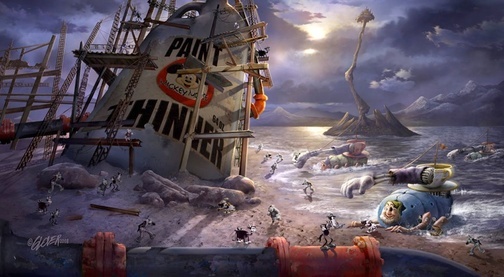
If you'd told me a decade back that someone would make a dark, scary game featuring Mickey Mouse, I would've laughed. But since then we've had Kingdom Hearts, where Mickey is a badass, black-cloaked, keyblade-wielding king of a planet, and so times have changed. My actual reaction to the demo was that it wasn't dark enough.
The game was marketed as super edgy and unexpected, particularly in the amazing concept art. But I'm guessing the dark and edgy images didn't get past certain family-friendly higher-ups at the smile-like-you-mean-it monolith that is Disney. Instead the game looks like a fairly generic adventure game, complete with fetch-quests and collectible items hidden in bushes. The game's central mechanic - drawing things in with paint versus erasing them with thinner - flirts dangerously close with being your standard black-and-white moral choice system where angelic good and satanic evil are your only two options.
There's been some nod to the idea that, as designer Warren Spector put it, "play style matters," in that there are multiple ways to solve various quests and/or puzzles, and which choice you make effects the game characters and game world. Okay, fine. I appreciate the effort, I guess. But I would've gladly sacrificed that element of choice if the game had instead delivered on the darker aesthetic that was promised in these amazing pictures.
Fable 3
Speaking of black and white moral choice systems, I also played the Fable 3 demo at E3. I ended up playing side-by-side with a friend who was at the neighboring console, where he got a mission that involved beating up giant mechanical vulture statues and shadow monsters from dripping pillars of darkness, and I got a mission that involved dressing up in a giant chicken suit to round up some missing hens.
Sigh.
I don't really know what to say about Fable. I never played the second one, so my only point of comparison is the first game, which isn't really a comparison at all. I can't tell you if this game is trying to be a Sims-like life simulator in a fantasy setting with more direct control, or a gritty fantasy action game a la God of War, or something else entirely. The two demos were so disparate, it felt like they came from different games. Nevertheless, I'm not sure I'd say I didn't like it, per se. I guess I was too confused to really get a full impression. Mostly it seemed kind of funny and interesting, but I'm not sure it'd be enough to hold my interest for the full game length.
Lost in Shadow
This was one of the few games I played at E3 that I had never heard of before, as I imagine most others haven't either. The idea was that you play as a shadow of a person, navigating across the shadows of a physical world. The environments reminded me strongly of Ico, which endeared me to it immediately, and the puzzles were just bordering between intuitively easy and clever (but then, I only played the very beginning; I'd imagine they get harder). As a shadow person, you run across the shadow platforms created by railings, walls, and so forth, while avoiding sunlit drops and the spiky shadows cast by the tops of gates and things. You have some limited control over what happens in the physical world, which allows you to change the way shadows are cast, and therefore how you can move. As a mechanic it has a lot of potential, although I didn't really get to play enough to see if the makers capitalized on that potential.
What this game really reminded me of was a more polished version of many indie games, which tend towards side-scrolling action-platformers; essentially what this game is. It reminded me of something like Closure, say, or Shift (both games that I loved and highly recommend - they're free online flash games, and the latter has a number of equally interesting sequels) where you have one central mechanic that's exploited in a variety of interesting ways. The relative interesting-ness of Lost in Shadow's puzzles and mechanical exploits remains to be seen. I'm considering picking this one up when it comes out largely from pure curiosity, and a desire to encourage the game industry to try more interesting things.
Kingdom Hearts: Birth by Sleep
I went into E3 HUGELY looking forward to this game, so it's almost not even fair for me to comment on it. I played a little bit of Deep Space, which is apparently Stitch's level, as well as an unknown generic Disney area, and all I can really say is that I saw nothing that would make me hesitate to buy the game.
What I saw of the (slightly) new combat mechanics (rechargeable special moves) seems interesting, and I've heard bizarrely fascinating things about the leveling up system (a board-game based mini-game?!), but the bottom line is that I'm in this for the story and the world-building, and for that you need to play the full game to give it a thumbs up or a thumbs down. I trust Squeenix, and I trust the Kingdom Hearts franchise. Every time I've been skeptical so far (a card-based battle system? A third girl who looks EXACTLY like Kairi and Namine?) they've managed to allay my fears and provide me with a solid, fun gaming experience, and so I'm willing to just take their word on this one and get it. The real question is, can I justify getting another PSP enough to buy the super special bundle pack when it comes out?
Okami-den
It's Okami but with baby animals on the DS. Enough said. I'm sold.
Avatar: The Last Airbender
This is a tough one for me, as I'm a huge fan of the animated series, and am feeling some serious trepidation about seeing the movie. Even if you're not a fan, though, I have a hard time seeing how this game could excite you. Looked at independent from its IP, the demo seemed like a fairly generic Wii game, where you press A repeatedly to attack, and then give a directional swing of the wiimote when the pop-up command indicates that you should do so. It might as well be God of War with exercise for your wrist instead of your thumb.
As an example of the Airbender IP, I really couldn't tell you. The character you play in the demo is the Blue Spirit, a character who doesn't use any form of bending - only physical combat. Which makes me wonder why they made that decision for the demo, since bending is the central mechanic of the series, and the action that the players will be most eager to perform in the game. It should be the most interesting part of the game, and the one that would be best suited to the Wii motion controls. So why didn't they demo that? Are they ashamed of how generic it is? If it's the same as the combat that was in the demo, then they should be. The A:tLA brand presents amazing opportunities for a motion control system, and unfortunately, I think this game is going to be just another lame movie-tie-in brand extension. I'd love to be proved wrong on this one, but somehow I doubt it.
Ghost Trick
Apparently this game is from the same developers as the Phoenix Wright series, and it shows. In this DS title, you play as a ghost that can posses items in the world and cause them to perform actions, or "tricks." You've lost your memory, and so the game is about trying to figure out who you were and why you died. The mechanic is simple, and I can't imagine all that much you could do with it past a certain point, but the demo was adorable and really quite funny (and broke the fourth wall in some very refreshing ways), and so I may have to pick this one up just for the sheer novelty. I think it's worth playing a game just for the sake of silliness every now and again.
Kirby: Epic Yarn
What you can say for this game, aside from "it's a Kirby game," is that it has quite the interesting aesthetic. I'm not sure I've ever seen "yarn-punk" before, but this would probably fit that description, if anything would. (Or, perhaps, "yarn-core"?) The game takes place in a fabric world, where you and everyone else are made of yarn. That's right, yarn. You're a little yarn outline, fighting other yarn outlines. You jump on stitches, hide between layers of fabric, and swing from buttons. Altogether, the aesthetic is fairly seamless (no pun intended), and affords some interesting mechanics and visuals.
The game is co-op for the Wii, and I played with a friend of mine that I was touring around with. The co-op reminded me a little bit of playing Four Swords, and also of the LittleBigPlanet 2 demo, in that there was a lot of, "Hey! Put me down!" and "Oh, sorry, I didn't mean to grab you!" and "Throw me over the ledge! Throw me over the ledge!" But I'm of the opinion that we should have more games like that, so count it as a positive aspect coming from me.
Other than that, not much to say about this game. Playful, adorable adventures. Kirby. From those key words, I think you should know what you need to know about whether you'll like it or not. Oh, and the two playable characters combined to form a giant tank made of yarn at one point. I guess that bears mentioning.
Overall Impressions
E3 was loud, it was glittery, it was full of shine far past the point of substance, but I think there was still enough meat buried under there that I feel confident about what's coming up in the industry and in the market. I could care less about generic shooters 1, 2, and 3, but there was a surprisingly high amount of content at the convention that wasn't generic, and even many of the sequels seemed like they were trying to push themselves and do something new. Overall, I think we're going to be okay. (And also, I'm seriously looking forward to more news on 'El Shaddai.' That trailer has some really darn pretty sequences. And also also, OMFG Portal 2 trailer. Seriously.)
Friday, February 27, 2009
Readings in Narrative Theory: The Rhetoric of Fiction
I have saved the best of my narrative theory summaries for last with Wayne C. Booth's classic The Rhetoric of Fiction (second edition). This book and this critic have been cited in nearly ever other narrative theory work I've read (at least, the ones that came out after this book was published). To be quite frank, I can see why. Not only is he complete and insightful, he is also clear and concise. Therefore, before I get to the actual text, I would like to begin this post with a short note about writing style and readability.
It is a painful task for students, scholars, and general audience readers to have to slog through a badly-written text, particularly an academic text. Writing clearly and obviously is a skill that many academics seem to lack. If your text is indecipherable to the average reader outside the field, this does not automatically make it a good text. In fact, unless it is about a topic so specific that such language and obscurity is required, I would even go so far as to say that this automatically makes it a bad text.
I've heard excuses before like, "This author is very dense, and you have to read him several times to truly understand what he's talking about." But in my mind, this is not an acceptable excuse. Booth is very dense, and his text definitely benefits from re-reading, yet The Rhetoric of Fiction text is still entirely accessible. Compare, if you will, a selection from two narrative theory works. The first is from Reading for the Plot, by Peter Brooks. (Brooks, Peter. Reading for the Plot. New York: Knopf, 1984.) The second is from the Booth book:
"Plot, then, might best be thought of as an "overcoding" of the proairetic by the hermeneutic, the latter structuring the discrete elements of the former into larger interpretive wholes, working out their play of meaning and significance. If we interpret the hermeneutic to be a general gnomic code, concerned not narrowly with enigma and its resolution but broadly with our understanding of how actions come to be semiotically structured, through an interrogation of their point, their goal, their import, we find that Barthes contributes to our conception of plot as part of the dynamics of reading." (Brooks, page 18)
"For experienced readers a sonnet begun calls for a sonnet concluded; an elegy begun in blank verse calls for an elegy completed in blank verse. Even so amorphous a genre as the novel, with hardly any established conventions, makes use of this kind of interest: when I begin what I think is a novel, I expect to read a novel throughout, unless the author can, like Sterne, transform my idea of what a novel can be." (Booth, page 127)
To me, the latter paragraph displays a high degree of skill in communication. While the relative value of the subject matter may be something for critics to debate, the forms in which the subjects are related are clearly of very disparate quality.
There are three reasons, I think, why a critic might write with the former tone rather than the latter. The first is a lack of ability to communicate clearly, either through an intrinsic inability or perhaps the blunting of communication skills through too much exposure to similar academia. Judging by the prestigious list of schools attached to Brooks's name, I would hesitate to attach such lack of skill to the man. Especially considering he is working in a field dealing with the English language, if anyone should be able to communicate effectively, it should be him.
The second reason a critic might write with such obfuscating language is that the subject matter is so detailed and in-depth that it defies more conventional language. I think this excuse is dangerous territory, although it may often be the justification that writers use for themselves. Booth covers very detailed and nuanced ground with perfect clarity. My suspicion is that Brooks's own points have the potential to be captured just as neatly, with the right choice of language.
The third reason is a selfish and misguided one, and that is a certain pretension of appearance. The idea that such language will keep those who are "not worthy" from understanding the subject matter, or the idea that there should be no reason why the author should have to "dumb down" his language for the sake of his audience. Clear communication is not dumbing-down - in fact it shows the author's skill more clearly. Not only that, clear communication allows readers of all levels to enjoy a work and to absorb the ideas it contains, which should be the goal of any author who is convinced that his ideas have merit. I can't claim to be an expert in such clarity myself, but I think it is something that one should strive for.
I'm not sure which of these three reasons - if any - afflict our dear Mr. Brooks, but I do have to say that I was disappointed with his text. I think the writing style is an unpleasant barrier to the understanding of his work, and that his ideas suffer for it. It is my hope and my goal to write in a clear, understandable way. If I am not, feel free to call me on it.
Anyway. Now that I've gotten that particular vitriolic rant off my chest (I apologize - sometimes I get a little too passionate about these things), on to Booth.
Booth, Wayne C. The Rhetoric of Fiction. Second Edition. Chicago and London: The University of Chicago Press, 1961, 1983 (second edition).
I've found much of interest in my reading of Booth, even beyond what directly relates to my project. For anyone doing anything even tangentially related to narrative theory, I would include this work as a must-read (even somewhat dated as it is). Don't be afraid of its large size - it's relatively easy to read (for an academic text, very easy). Because of space limitations (this entry will be quite long as it is), I will only cover the areas I found directly related to my work, but even so, there are multiple. I will therefore be dividing up the rest of this post into segments based on focus.
Section 1: Reader Objectivity / Player/Character Empathy
As readers of this blog might remember from previous posts, I have a particular interest in the ability of games to give the player a strong emotional connection to the character she plays. In the novel, it is much more difficult, requiring great skill on the part of the author, to give the reader a sense of emotional connection to his characters, especially if the characters are very different from the reader. (Booth compares the reaction of two readers - one with a lisp and one without, to a character that speaks with a lisp. Obviously the more similar reader will react more strongly to the character.)
I will not go into too much depth at the moment about how this technique of empathy is evoked, since I do so not only in previous posts, but also in the section below. Nevertheless, I would like to offer the quotes that Booth has on the subject.
[speaking about the tendency towards an "alienation effect," where good works are considered those that don't involve the emotions] "...the novelist will find himself in difficulties if he tries to discover some ideal distance that all works ought to seek. "Aesthetic distance" is in fact many different effects, some of them quite inappropriate to some kinds of works. More important, distance is never an end in itself; distance along one axis is sought for the sake of increasing the reader's involvement on some other axis." (123)
"It is only as I read that I become the self whose beliefs must coincide with the author's. Regardless of my real beliefs and practices, I must subordinate my mind and heart to the book if I am to enjoy it to the full. The author creates, in short, an image of himself and another image of his reader; he makes his reader, as he makes his second self, and the most successful reading is one in which the created selves, author and reader, can find complete agreement." (138)
"Much more important [than authorial commentary], the sustained inside view leads the reader to hope for good fortune for the character with whom he travels, quite independently of the qualities revealed." (246)
"While only immature readers ever really identify with any character, losing all sense of distance and hence all chance of an artistic experience, our emotional reaction to every event concerning Emma tends to become like her own. When she feels anxiety or shame, we feel analogous emotions. Our modern awareness that such "feelings" are not identical with those we feel in our own lives in similar circumstances has tended to blind us to the fact that aesthetic form can be built out of patterned emotions as well as out of other materials. It is absurd to pretend that because our emotions and desires in responding to fiction are in a very real sense disinterested, they do not or should not exist. Jane Austen, in developing the sustained use of a sympathetic inside view, has mastered one of the most successful of all devices for inducing a parallel emotional response between the deficient heroine and the reader." (249)
[on a lack of authorial commentary] "[Miranda] must be accepted at her own estimate from the beginning, and that estimate must, for greatest effect, be as close as possible to the reader's estimate of his own importance. Whether we call this effect identification or not, it is certainly the closest that literature can come to making us feel events as if they were happening to ourselves. As we read, we know only Miranda's world and we know only her values. Our only value becomes, in a sense, her well-being, and we accept any threat to her happiness precisely as she accepts it. The slightest suggestion that she is at fault will create too much distance; the slightest sign that author and reader are observing Miranda from above rather than alongside will destroy at least in part, the quality of our concern and hence of our final revelation." (277)
"This kind of near-identification can be used for innumerable effects. [...] A motion picture can achieve this kind of thrill perhaps more easily than any other medium, but the devices of showing developed by modern fiction can do it well." (277)
"And then he is gone. He is dead, and we have experienced a personal loss, a personal blow, of a kind that would be difficult, perhaps impossible, to achieve with a technique which provided us with any clear moral or intellectual guidance about the meaning of his death." (278)
Section 2: Types of Literary Interest
Booth has a very interesting section in his text where he discusses the "types of literary interest," or the elements of fiction that keep our attention and force us to continue the experience. While this is related to the idea of immersion, I think a look at how these interests relate to games may deserve an additional section of its own.
Booth breaks up literary interest into three types: intellectual interests, completion of qualities, and what he calls practical interests, but which I shall call empathic concerns (since I feel that more accurately captures the sort of interests he describes).
Intellectual interests refers to curiosity. We have a sort of impartial, academic interest in facts and in how the story will play out. Completion of qualities refers to pattern recognition and the desire for pattern completion. Booth includes in this all types of pattern completion, from story concerns - capture and punishment being the natural completion of crime, and so on - to more formal concerns dealing with the literary discourse (the form of the story rather than the content) itself, as described in the first quote ("a sonnet begun calls for a sonnet concluded..."). Finally, empathic concern deals with our relation to the characters, and our desire to see things unfold based on how we relate to them. We would like to see sympathetic characters have happy endings, villainous characters get their just desserts, and so on.
Booth's analysis of these three aspects and how they interact with one another is quite in-depth, and I will not go into all of it here. (If you're curious about it, it's in chapter V of the book, beginning page 125.) What I would like to discuss is how these types of interest might relate to game studies. Let's put side by side the way each of the three interests work in both media.
Intellectual interest in the novel: I am curious about how this strange egg came to be in the middle of the field. I am curious about what the egg is. I am curious about what will happen if the main character goes up to the egg and touches it. I keep reading, hoping that the author will see fit to answer these questions.
Intellectual interest in the game: I am curious about how this strange egg came to be in the middle of the field. I am curious about what the egg is. I am curious about what will happen if the main character goes up to the egg and touches it. I go up to the egg and touch it, definitely answering at least the final question, and hoping that my interest will trigger further information about the first two.
The interest has gone from a passive experience to an active one. In the case of intellectual interest, a game can be directed by the specific interest of the player, allowing for more engagement - the player need not rely, as the reader must, on the good grace of the game's creator to focus in on what the player finds interesting. The player chooses the area of focus. However, she must still rely on the game designer to create the game in such a way as to allow it to respond to her curiosity in a satisfactory manner. The game designer can accomplish this by making as much as possible of the environment reactant. A reader, on the other hand, must hope that the author's area of intellectual curiosity matches up with her own, because only the author determines what areas of the novel are further explored.
The completion of qualities area is similar. Rather than waiting in suspense to see if the author will complete the patterns I see forming in the novel, I will actively seek out these pattern completions in a game, if I find them desirous. However, this does remove one element crucial to the enjoyment of the novel - suspense. Because he maintains total control, the author can withhold the completion of certain patterns as a method of keeping the reader interested. When the player can actively seek out completion, the suspense is weakened, if not destroyed.
Pattern recognition is also an integral aspect of gameplay, and the learning inherent in gameplay. Players learn that certain actions are available, and will have certain effects. Unlike the real world, the effects of actions in a game are generally consistent. We build our experience of playing the game through learning to recognize and use patterns, in fighting, in problem-solving, and in a number of other ways. Many players gain pleasure from the repetitions of certain patterns, as in the steadily increasing difficulty of certain puzzle games, where the answer to each new puzzle incorporates skills and tricks learned in previous puzzles, and a recombining and shifting of patterns produces new results, which can then be added to the player's repertoire of puzzle solutions for use on future puzzles.
Finally, empathic concerns. This, as touched upon previously, is an area where games really shine. Controlling the empathic relations of a character with their reader is exceedingly tricky business in a novel, and requires a good deal of skill on the part of the author. A game, on the other hand, generally starts with an advantage, given that the character is under the control of the player, and thus the player is forced to relate to their actions (as they are the player's actions as well). We have a very personal stake in whether the story will work out well for the main character, because this happy ending likely coincides with our successful completion of the game. There are, of course, exceptions to the happy ending - but we still tend to presume that we are moving the character towards a certain goal, and that the goal is somehow desirous, at least for the player. Our empathic concern is less necessarily for the happiness of this character, but more of the success of ourselves as players. Nevertheless, this method still operates by harnessing the same sort of interest as does our empathic concerns for a character in a novel. The focus has just shifted from an exclusive focus on the character to a mixed focus on the character and ourselves.
A combination of these three elements of interest are why I think games have a tendency to be "addictive." Combining a high degree of emotional resonance with the pleasure of repeated pattern recognition (technical, at the very least) and the ability to actively pursue the objects of one's curiosity combine to capture the audience's interest and hold it fast.
Here are some relevant quotes from this section of Booth:
"...our desire for causal completion is one of the strongest of interests available to the author. Not only do we believe that certain causes do in life produce certain effects; in literature we believe that they should. Consequently, we ordinary readers will go to great lengths, once we have been caught up by an author who knows how to make use of this interest, to find out whether our demands will be met." (126)
"If we look closely at our responses to most great novels, we discover that we feel a strong concern for the characters as people; we care about their good and bad fortune. [...] It is of course true that our desires concerning the fate of such imagined people differ markedly from our desires in real life. We will accept destruction of the man we love, in a literary work, if destruction is required to satisfy our other interests; we will take pleasure in combinations of hope and fear which in real life would be intolerable. But hope and fear are there, and the destruction or salvation is felt in a manner closely analogous to the feelings produced by such events in real life." (129-130)
"Such [emotional] concerns are not simply a necessary but impure base, as Ortega would have it, to "make contemplation possible" but "with no aesthetic value or only a reflected or secondary one" (pp. 80, 76). In many first-rate works they are the very core of our experience. We may refuse assent when an author tries to manipulate us too obviously or cheaply with a casual bestowal of goodness or intellectual brilliance or beauty or charm. We all have use for epithets like "melodramatic" to apply against abuses of this kind. But his does not mean that human interest in itself is cheap. It is true that our involvement in the fate of Raskolnikov is not different in kind from the involvement sought by the most sentimental of novels. But in the great work we surrender our emotions for reasons that leave us with no regrets, no inclination to retract, after the immediate spell is past. They are, in fact, reasons which we should be ashamed not to respond to." (130-131)
"...it is clear that no great work is based on only one interest. Whenever a work tends towards an exclusive reliance on intellectual interests, on the contemplation of qualities, or on practical desires we all look for adjectives to whip the offender with; a mere "novel of ideas," a mere "desiccated form," a mere "tear-jerker" will offend all but the small handful of critics and authors who are momentarily absorbed in pushing one interest to the limit." (133)
Section 3: Person / POV
I don't have much to offer in the way of quotes for this section, but I am impressed nonetheless by the incredibly nuanced view which Booth takes towards the idea of "point of view" in literature, from distinguishing between "person" in the traditional manner to more complex ideas of "dramatized narrators" and so on. What I think is very interesting about point of view in games is the way that certain games embody what we often think of as traditional points of view.
A game is almost always told from the point of view of the PC. This makes the PC the "narrator-agent," as it were, or the narrator who is also a character in the story. However, the character also shares the experience of being the implied reader as well, as he is the intended avatar for the player within the game, and thus all responses to the player's input will be received via the game's relation to this character. In the same way as a text is "speaking" to the implied reader, the game is "reacting" to the character, which is implied to be the player. Narrative theory will have to come up with a whole new terminology to describe exactly what position the player and the PC hold within the narrative - games have a tendency to twist the existing terms to their breaking points.
Oddly enough however, what we think of as some of the most basic and elementary (in the sense of sort of juvenile, in addition to simple) categories of literary point of view hold true in games, and do so in ways that provide an interesting visualization for how we think of the literary equivalents.
First-Person
First-person games present a camera situated "behind the eyes" of the PC. Only the hands and perhaps some of the arms can be seen of the character being played. We see of the character and of the world only what we would see of ourselves if we were in the same situation, thus helping to increase our sense of being the character in question, the limited "I" perspective.
Third-Person Limited
Third-person games such as RPGs have a camera situated behind and usually slightly above the main character. We see the figure of the character from the outside, and a portion of the surrounding environment. This gives us a sense of greater grasp over the world/map, perhaps seeing some things that the character himself might not be able to. Thus we increase the scope of our viewpoint while limiting our identification with the character.
Third-Person Omniscient
Common to RTS and other God games, this perspective puts the camera high above the ground, allowing the player to see large portions of the world at once, and to move back and forth across the world independent of any particular character. This is also the only viewpoint where the player is not specifically relating to a single character in the game. In this perspective, we lose almost all empathy with individual characters - more often than not, characters are resources rather than individuals, and the player is an invisible god-force that controls their actions. With our view at its fullest availability, we sacrifice the most player/character empathy with any single character.
It would be very interesting to me to see these perspectives related, in turn, back to the literary medium, but I do feel that this is somewhat outside the scope of this project.
In conclusion, go read Booth. It will quite likely be less tiring than what you have just finished.
It is a painful task for students, scholars, and general audience readers to have to slog through a badly-written text, particularly an academic text. Writing clearly and obviously is a skill that many academics seem to lack. If your text is indecipherable to the average reader outside the field, this does not automatically make it a good text. In fact, unless it is about a topic so specific that such language and obscurity is required, I would even go so far as to say that this automatically makes it a bad text.
I've heard excuses before like, "This author is very dense, and you have to read him several times to truly understand what he's talking about." But in my mind, this is not an acceptable excuse. Booth is very dense, and his text definitely benefits from re-reading, yet The Rhetoric of Fiction text is still entirely accessible. Compare, if you will, a selection from two narrative theory works. The first is from Reading for the Plot, by Peter Brooks. (Brooks, Peter. Reading for the Plot. New York: Knopf, 1984.) The second is from the Booth book:
"Plot, then, might best be thought of as an "overcoding" of the proairetic by the hermeneutic, the latter structuring the discrete elements of the former into larger interpretive wholes, working out their play of meaning and significance. If we interpret the hermeneutic to be a general gnomic code, concerned not narrowly with enigma and its resolution but broadly with our understanding of how actions come to be semiotically structured, through an interrogation of their point, their goal, their import, we find that Barthes contributes to our conception of plot as part of the dynamics of reading." (Brooks, page 18)
"For experienced readers a sonnet begun calls for a sonnet concluded; an elegy begun in blank verse calls for an elegy completed in blank verse. Even so amorphous a genre as the novel, with hardly any established conventions, makes use of this kind of interest: when I begin what I think is a novel, I expect to read a novel throughout, unless the author can, like Sterne, transform my idea of what a novel can be." (Booth, page 127)
To me, the latter paragraph displays a high degree of skill in communication. While the relative value of the subject matter may be something for critics to debate, the forms in which the subjects are related are clearly of very disparate quality.
There are three reasons, I think, why a critic might write with the former tone rather than the latter. The first is a lack of ability to communicate clearly, either through an intrinsic inability or perhaps the blunting of communication skills through too much exposure to similar academia. Judging by the prestigious list of schools attached to Brooks's name, I would hesitate to attach such lack of skill to the man. Especially considering he is working in a field dealing with the English language, if anyone should be able to communicate effectively, it should be him.
The second reason a critic might write with such obfuscating language is that the subject matter is so detailed and in-depth that it defies more conventional language. I think this excuse is dangerous territory, although it may often be the justification that writers use for themselves. Booth covers very detailed and nuanced ground with perfect clarity. My suspicion is that Brooks's own points have the potential to be captured just as neatly, with the right choice of language.
The third reason is a selfish and misguided one, and that is a certain pretension of appearance. The idea that such language will keep those who are "not worthy" from understanding the subject matter, or the idea that there should be no reason why the author should have to "dumb down" his language for the sake of his audience. Clear communication is not dumbing-down - in fact it shows the author's skill more clearly. Not only that, clear communication allows readers of all levels to enjoy a work and to absorb the ideas it contains, which should be the goal of any author who is convinced that his ideas have merit. I can't claim to be an expert in such clarity myself, but I think it is something that one should strive for.
I'm not sure which of these three reasons - if any - afflict our dear Mr. Brooks, but I do have to say that I was disappointed with his text. I think the writing style is an unpleasant barrier to the understanding of his work, and that his ideas suffer for it. It is my hope and my goal to write in a clear, understandable way. If I am not, feel free to call me on it.
Anyway. Now that I've gotten that particular vitriolic rant off my chest (I apologize - sometimes I get a little too passionate about these things), on to Booth.
Booth, Wayne C. The Rhetoric of Fiction. Second Edition. Chicago and London: The University of Chicago Press, 1961, 1983 (second edition).
I've found much of interest in my reading of Booth, even beyond what directly relates to my project. For anyone doing anything even tangentially related to narrative theory, I would include this work as a must-read (even somewhat dated as it is). Don't be afraid of its large size - it's relatively easy to read (for an academic text, very easy). Because of space limitations (this entry will be quite long as it is), I will only cover the areas I found directly related to my work, but even so, there are multiple. I will therefore be dividing up the rest of this post into segments based on focus.
Section 1: Reader Objectivity / Player/Character Empathy
As readers of this blog might remember from previous posts, I have a particular interest in the ability of games to give the player a strong emotional connection to the character she plays. In the novel, it is much more difficult, requiring great skill on the part of the author, to give the reader a sense of emotional connection to his characters, especially if the characters are very different from the reader. (Booth compares the reaction of two readers - one with a lisp and one without, to a character that speaks with a lisp. Obviously the more similar reader will react more strongly to the character.)
I will not go into too much depth at the moment about how this technique of empathy is evoked, since I do so not only in previous posts, but also in the section below. Nevertheless, I would like to offer the quotes that Booth has on the subject.
[speaking about the tendency towards an "alienation effect," where good works are considered those that don't involve the emotions] "...the novelist will find himself in difficulties if he tries to discover some ideal distance that all works ought to seek. "Aesthetic distance" is in fact many different effects, some of them quite inappropriate to some kinds of works. More important, distance is never an end in itself; distance along one axis is sought for the sake of increasing the reader's involvement on some other axis." (123)
"It is only as I read that I become the self whose beliefs must coincide with the author's. Regardless of my real beliefs and practices, I must subordinate my mind and heart to the book if I am to enjoy it to the full. The author creates, in short, an image of himself and another image of his reader; he makes his reader, as he makes his second self, and the most successful reading is one in which the created selves, author and reader, can find complete agreement." (138)
"Much more important [than authorial commentary], the sustained inside view leads the reader to hope for good fortune for the character with whom he travels, quite independently of the qualities revealed." (246)
"While only immature readers ever really identify with any character, losing all sense of distance and hence all chance of an artistic experience, our emotional reaction to every event concerning Emma tends to become like her own. When she feels anxiety or shame, we feel analogous emotions. Our modern awareness that such "feelings" are not identical with those we feel in our own lives in similar circumstances has tended to blind us to the fact that aesthetic form can be built out of patterned emotions as well as out of other materials. It is absurd to pretend that because our emotions and desires in responding to fiction are in a very real sense disinterested, they do not or should not exist. Jane Austen, in developing the sustained use of a sympathetic inside view, has mastered one of the most successful of all devices for inducing a parallel emotional response between the deficient heroine and the reader." (249)
[on a lack of authorial commentary] "[Miranda] must be accepted at her own estimate from the beginning, and that estimate must, for greatest effect, be as close as possible to the reader's estimate of his own importance. Whether we call this effect identification or not, it is certainly the closest that literature can come to making us feel events as if they were happening to ourselves. As we read, we know only Miranda's world and we know only her values. Our only value becomes, in a sense, her well-being, and we accept any threat to her happiness precisely as she accepts it. The slightest suggestion that she is at fault will create too much distance; the slightest sign that author and reader are observing Miranda from above rather than alongside will destroy at least in part, the quality of our concern and hence of our final revelation." (277)
"This kind of near-identification can be used for innumerable effects. [...] A motion picture can achieve this kind of thrill perhaps more easily than any other medium, but the devices of showing developed by modern fiction can do it well." (277)
"And then he is gone. He is dead, and we have experienced a personal loss, a personal blow, of a kind that would be difficult, perhaps impossible, to achieve with a technique which provided us with any clear moral or intellectual guidance about the meaning of his death." (278)
Section 2: Types of Literary Interest
Booth has a very interesting section in his text where he discusses the "types of literary interest," or the elements of fiction that keep our attention and force us to continue the experience. While this is related to the idea of immersion, I think a look at how these interests relate to games may deserve an additional section of its own.
Booth breaks up literary interest into three types: intellectual interests, completion of qualities, and what he calls practical interests, but which I shall call empathic concerns (since I feel that more accurately captures the sort of interests he describes).
Intellectual interests refers to curiosity. We have a sort of impartial, academic interest in facts and in how the story will play out. Completion of qualities refers to pattern recognition and the desire for pattern completion. Booth includes in this all types of pattern completion, from story concerns - capture and punishment being the natural completion of crime, and so on - to more formal concerns dealing with the literary discourse (the form of the story rather than the content) itself, as described in the first quote ("a sonnet begun calls for a sonnet concluded..."). Finally, empathic concern deals with our relation to the characters, and our desire to see things unfold based on how we relate to them. We would like to see sympathetic characters have happy endings, villainous characters get their just desserts, and so on.
Booth's analysis of these three aspects and how they interact with one another is quite in-depth, and I will not go into all of it here. (If you're curious about it, it's in chapter V of the book, beginning page 125.) What I would like to discuss is how these types of interest might relate to game studies. Let's put side by side the way each of the three interests work in both media.
Intellectual interest in the novel: I am curious about how this strange egg came to be in the middle of the field. I am curious about what the egg is. I am curious about what will happen if the main character goes up to the egg and touches it. I keep reading, hoping that the author will see fit to answer these questions.
Intellectual interest in the game: I am curious about how this strange egg came to be in the middle of the field. I am curious about what the egg is. I am curious about what will happen if the main character goes up to the egg and touches it. I go up to the egg and touch it, definitely answering at least the final question, and hoping that my interest will trigger further information about the first two.
The interest has gone from a passive experience to an active one. In the case of intellectual interest, a game can be directed by the specific interest of the player, allowing for more engagement - the player need not rely, as the reader must, on the good grace of the game's creator to focus in on what the player finds interesting. The player chooses the area of focus. However, she must still rely on the game designer to create the game in such a way as to allow it to respond to her curiosity in a satisfactory manner. The game designer can accomplish this by making as much as possible of the environment reactant. A reader, on the other hand, must hope that the author's area of intellectual curiosity matches up with her own, because only the author determines what areas of the novel are further explored.
The completion of qualities area is similar. Rather than waiting in suspense to see if the author will complete the patterns I see forming in the novel, I will actively seek out these pattern completions in a game, if I find them desirous. However, this does remove one element crucial to the enjoyment of the novel - suspense. Because he maintains total control, the author can withhold the completion of certain patterns as a method of keeping the reader interested. When the player can actively seek out completion, the suspense is weakened, if not destroyed.
Pattern recognition is also an integral aspect of gameplay, and the learning inherent in gameplay. Players learn that certain actions are available, and will have certain effects. Unlike the real world, the effects of actions in a game are generally consistent. We build our experience of playing the game through learning to recognize and use patterns, in fighting, in problem-solving, and in a number of other ways. Many players gain pleasure from the repetitions of certain patterns, as in the steadily increasing difficulty of certain puzzle games, where the answer to each new puzzle incorporates skills and tricks learned in previous puzzles, and a recombining and shifting of patterns produces new results, which can then be added to the player's repertoire of puzzle solutions for use on future puzzles.
Finally, empathic concerns. This, as touched upon previously, is an area where games really shine. Controlling the empathic relations of a character with their reader is exceedingly tricky business in a novel, and requires a good deal of skill on the part of the author. A game, on the other hand, generally starts with an advantage, given that the character is under the control of the player, and thus the player is forced to relate to their actions (as they are the player's actions as well). We have a very personal stake in whether the story will work out well for the main character, because this happy ending likely coincides with our successful completion of the game. There are, of course, exceptions to the happy ending - but we still tend to presume that we are moving the character towards a certain goal, and that the goal is somehow desirous, at least for the player. Our empathic concern is less necessarily for the happiness of this character, but more of the success of ourselves as players. Nevertheless, this method still operates by harnessing the same sort of interest as does our empathic concerns for a character in a novel. The focus has just shifted from an exclusive focus on the character to a mixed focus on the character and ourselves.
A combination of these three elements of interest are why I think games have a tendency to be "addictive." Combining a high degree of emotional resonance with the pleasure of repeated pattern recognition (technical, at the very least) and the ability to actively pursue the objects of one's curiosity combine to capture the audience's interest and hold it fast.
Here are some relevant quotes from this section of Booth:
"...our desire for causal completion is one of the strongest of interests available to the author. Not only do we believe that certain causes do in life produce certain effects; in literature we believe that they should. Consequently, we ordinary readers will go to great lengths, once we have been caught up by an author who knows how to make use of this interest, to find out whether our demands will be met." (126)
"If we look closely at our responses to most great novels, we discover that we feel a strong concern for the characters as people; we care about their good and bad fortune. [...] It is of course true that our desires concerning the fate of such imagined people differ markedly from our desires in real life. We will accept destruction of the man we love, in a literary work, if destruction is required to satisfy our other interests; we will take pleasure in combinations of hope and fear which in real life would be intolerable. But hope and fear are there, and the destruction or salvation is felt in a manner closely analogous to the feelings produced by such events in real life." (129-130)
"Such [emotional] concerns are not simply a necessary but impure base, as Ortega would have it, to "make contemplation possible" but "with no aesthetic value or only a reflected or secondary one" (pp. 80, 76). In many first-rate works they are the very core of our experience. We may refuse assent when an author tries to manipulate us too obviously or cheaply with a casual bestowal of goodness or intellectual brilliance or beauty or charm. We all have use for epithets like "melodramatic" to apply against abuses of this kind. But his does not mean that human interest in itself is cheap. It is true that our involvement in the fate of Raskolnikov is not different in kind from the involvement sought by the most sentimental of novels. But in the great work we surrender our emotions for reasons that leave us with no regrets, no inclination to retract, after the immediate spell is past. They are, in fact, reasons which we should be ashamed not to respond to." (130-131)
"...it is clear that no great work is based on only one interest. Whenever a work tends towards an exclusive reliance on intellectual interests, on the contemplation of qualities, or on practical desires we all look for adjectives to whip the offender with; a mere "novel of ideas," a mere "desiccated form," a mere "tear-jerker" will offend all but the small handful of critics and authors who are momentarily absorbed in pushing one interest to the limit." (133)
Section 3: Person / POV
I don't have much to offer in the way of quotes for this section, but I am impressed nonetheless by the incredibly nuanced view which Booth takes towards the idea of "point of view" in literature, from distinguishing between "person" in the traditional manner to more complex ideas of "dramatized narrators" and so on. What I think is very interesting about point of view in games is the way that certain games embody what we often think of as traditional points of view.
A game is almost always told from the point of view of the PC. This makes the PC the "narrator-agent," as it were, or the narrator who is also a character in the story. However, the character also shares the experience of being the implied reader as well, as he is the intended avatar for the player within the game, and thus all responses to the player's input will be received via the game's relation to this character. In the same way as a text is "speaking" to the implied reader, the game is "reacting" to the character, which is implied to be the player. Narrative theory will have to come up with a whole new terminology to describe exactly what position the player and the PC hold within the narrative - games have a tendency to twist the existing terms to their breaking points.
Oddly enough however, what we think of as some of the most basic and elementary (in the sense of sort of juvenile, in addition to simple) categories of literary point of view hold true in games, and do so in ways that provide an interesting visualization for how we think of the literary equivalents.
First-Person
First-person games present a camera situated "behind the eyes" of the PC. Only the hands and perhaps some of the arms can be seen of the character being played. We see of the character and of the world only what we would see of ourselves if we were in the same situation, thus helping to increase our sense of being the character in question, the limited "I" perspective.
Third-Person Limited
Third-person games such as RPGs have a camera situated behind and usually slightly above the main character. We see the figure of the character from the outside, and a portion of the surrounding environment. This gives us a sense of greater grasp over the world/map, perhaps seeing some things that the character himself might not be able to. Thus we increase the scope of our viewpoint while limiting our identification with the character.
Third-Person Omniscient
Common to RTS and other God games, this perspective puts the camera high above the ground, allowing the player to see large portions of the world at once, and to move back and forth across the world independent of any particular character. This is also the only viewpoint where the player is not specifically relating to a single character in the game. In this perspective, we lose almost all empathy with individual characters - more often than not, characters are resources rather than individuals, and the player is an invisible god-force that controls their actions. With our view at its fullest availability, we sacrifice the most player/character empathy with any single character.
It would be very interesting to me to see these perspectives related, in turn, back to the literary medium, but I do feel that this is somewhat outside the scope of this project.
In conclusion, go read Booth. It will quite likely be less tiring than what you have just finished.
Subscribe to:
Posts (Atom)


 Posts
Posts